
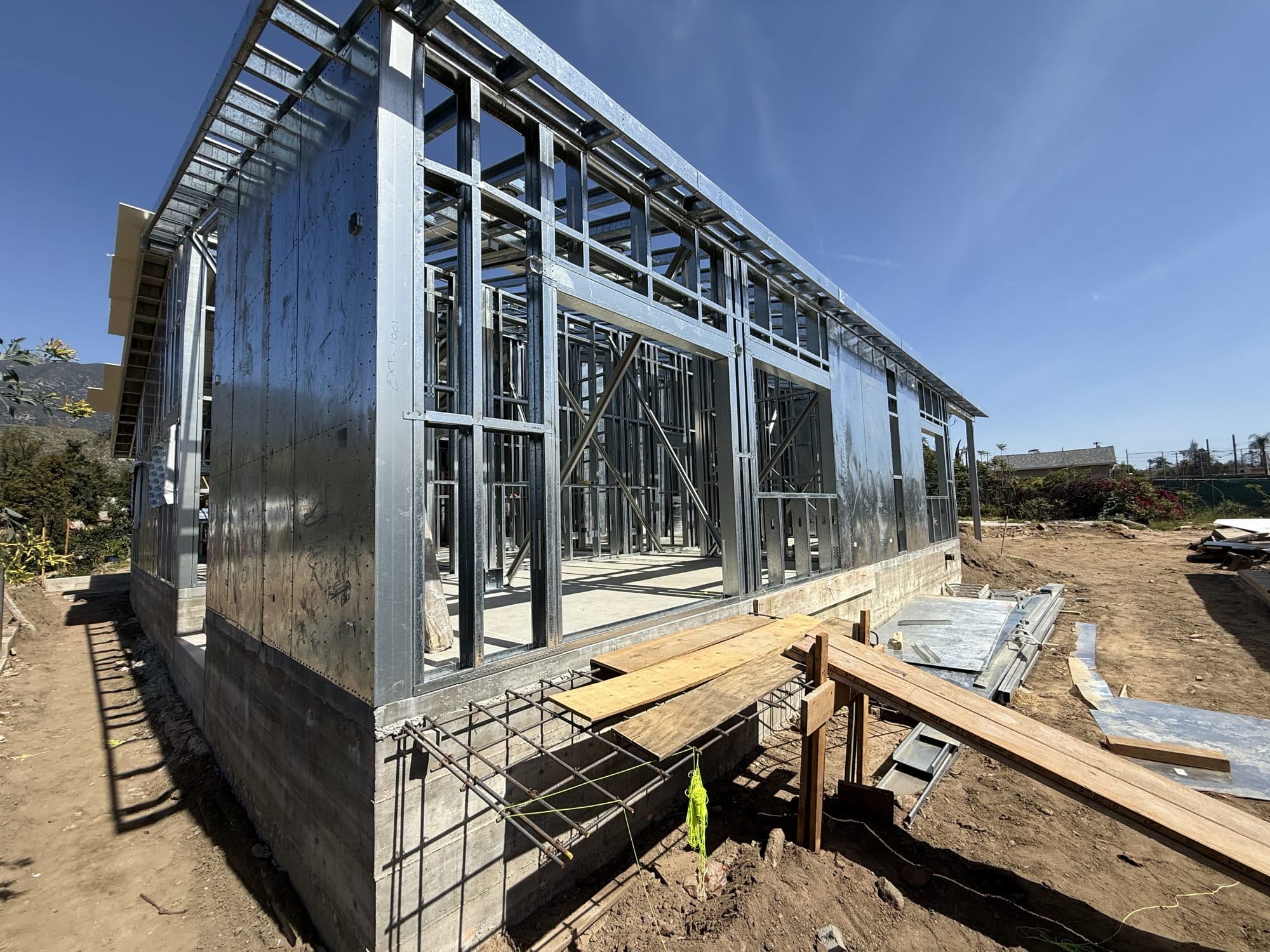
Steel vs. wood framing, honestly.
Wood built most of California, and it isn't going away. But for a home you plan to keep, especially in a fire-prone area, light-gauge steel changes the trade-offs. Here's the straight comparison, including where wood still makes sense.
Short answer: light-gauge steel framing is non-combustible, dimensionally stable, and immune to termites and rot, and it's well suited to factory prefabrication that holds a schedule. Wood is often cheaper up front and every crew knows it, so it can win on small, simple builds in low-risk areas. For fire safety, longevity, and consistency, steel pulls ahead, which is why LyteMods frames every home in it.
Side by side.
| Consideration | Light-gauge steel | Wood framing |
|---|---|---|
| Fire | Non-combustible, adds no fuel to a fire | Combustible, burns and feeds fire |
| Termites & pests | Inorganic, nothing to eat | Vulnerable, needs treatment and monitoring |
| Rot & mold | Won't rot; no food for mold | Can rot and support mold when wet |
| Dimensional stability | Won't shrink, warp, twist, or split | Shrinks, warps, and can twist over time |
| Consistency | Roll-formed to tight, repeatable tolerances | Varies board to board |
| Schedule at scale | Suited to factory prefab and parallel site work | More on-site, weather-dependent labor |
| Material cost | Higher per pound, but more stable pricing | Often cheaper, but prices swing widely |
| Familiarity | Fewer crews trained on it locally | Every framer knows it |
A checkmark marks where steel has the structural advantage. The last two rows are where wood can still win, we'd rather tell you that than pretend otherwise.