
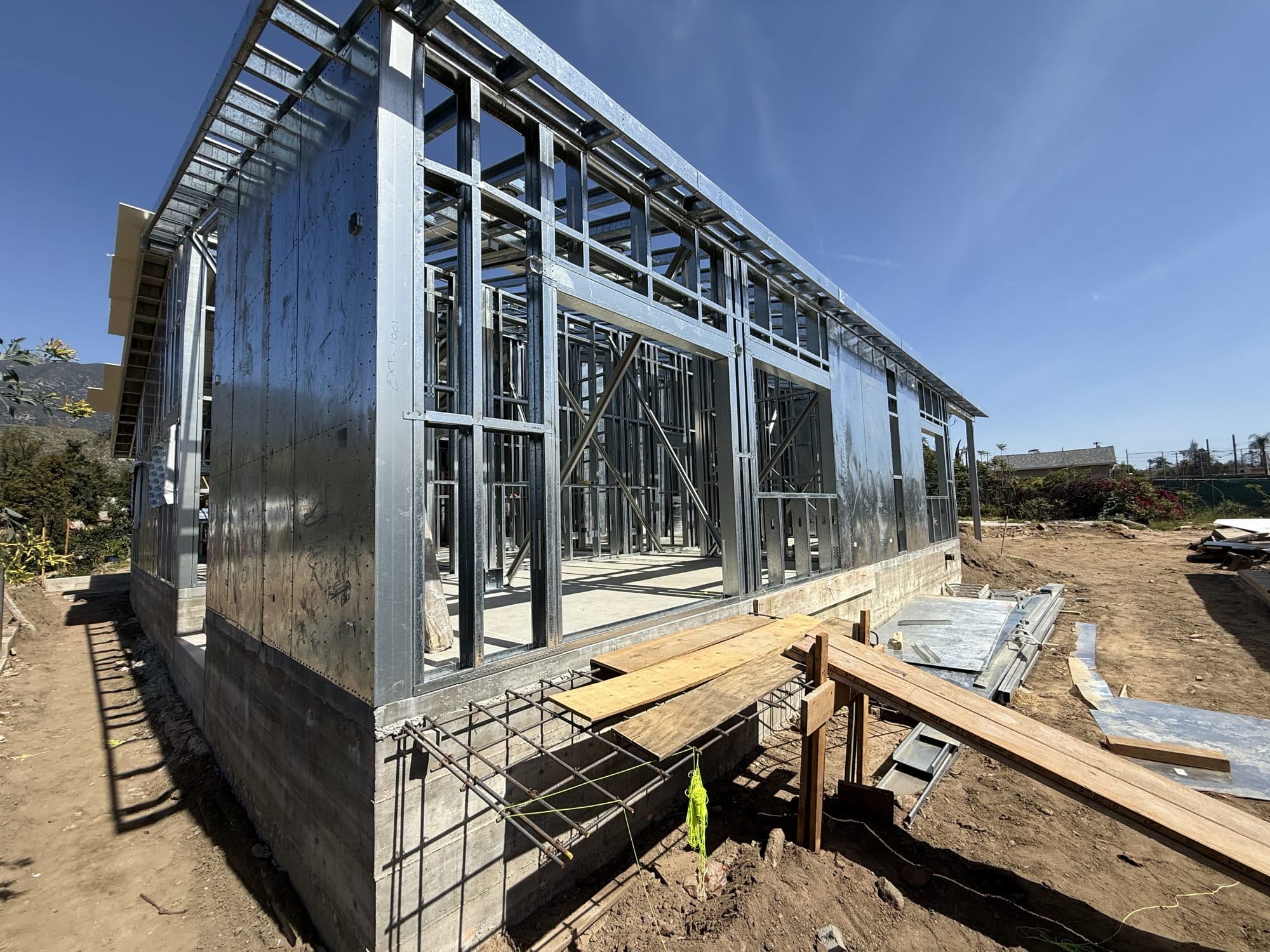
Smart wildfire defense, built in
The Fire Hardening Package, built in before the walls close.
A code-built envelope around a steel frame that does not burn, plus a sensor-driven exterior sprinkler system with its own water and backup power. Here is what is in it, what it costs, and what it honestly cannot do.
- Sensor-triggered
- Cellular alerts
- Solar + battery backup
- Non-combustible steel
Active Wildfire Defense
IllustrationArmed · watching sensors
- Trigger
- Your set temperature
- Sensors
- Temperature + flame
- Alerts
- Up to 5 phones
- Water
- Dedicated tank
- Power
- Solar + battery backup
Sits on top of Tier 1, the code-built Hardened Envelope.
- 2 tiers
- Hardened Envelope + Active Wildfire Defense
- 11
- protections built into Tier 1
- 5 phones
- alerted by the smart controller
- $20k to $90k+
- exterior system planning range, October 2026
01Overview
What is a fire hardening package?
Short answer: a fire hardening package is everything that makes a home harder for a wildfire to ignite, built in as one system. Ours has two tiers. Tier 1, the Hardened Envelope, is what California's wildfire code requires in a fire zone: a Class A roof, enclosed eaves, ember-resistant vents, ignition-resistant walls, tempered windows, and noncombustible decks and gutters, all around a light-gauge steel frame that does not burn. Tier 2, Active Wildfire Defense, adds an automatic exterior sprinkler system with its own water and backup power. Tier 2 sits on top of Tier 1. It never replaces it.
Updated . No home is fireproof, and no system guarantees a home survives a wildfire.
02Two tiers, one system
What goes where on the house.
Tier 1 · Hardened Envelope
1 / 101. Class A roof
The highest fire rating for a roof assembly. Wind-blown embers land on the roof first.
03Tier 1
The Hardened Envelope: what the wildfire code requires, around a frame that does not burn.
- Non-combustible steel frameLight-gauge steel studs, joists, and roof framing that do not burn. Standard on every LyteMods home, fire zone or not.ASTM E136
- Class A roofThe highest fire classification for a roof assembly, where wind-blown embers land first.CWUIC 504.2
- Enclosed eaves and protected soffitsNo open rafter tails for embers and heat to collect under.CWUIC 504.3
- Noncombustible gutters with ember guardsMetal gutters with a guard that keeps leaves and needles from piling up as tinder on the roof edge.CWUIC 504.4
- Ignition-resistant exterior wallsFire-rated siding over the steel frame.CWUIC 504.5
- Non-combustible decks and porchesWalking surfaces and the undersides of projections built to the wildfire code.CWUIC 504.7
- Tempered multi-pane windowsDual-pane glazing with at least one tempered pane, which resists breaking from radiant heat better than ordinary glass.CWUIC 504.8
- Wildfire-code exterior doorsExterior doors with noncombustible or ignition-resistant faces, or a tested assembly.CWUIC 504.9
- Flame- and ember-resistant ventsVents listed by the State Fire Marshal or tested to ASTM E2886, since vents are a common way embers get inside a house.CWUIC 504.10
- 6-inch flashing where walls meet the ground, decks, and roofsNoncombustible flashing at the joints where embers pile up against the wall.CWUIC Chapter 5
- Interior fire sprinklers and wired alarmsCalifornia's Residential Code requires automatic sprinklers in new one- and two-family homes, so they are in every new LyteMods home. Wired smoke and carbon monoxide alarms come with them.CRC R313
The first five feet are yours to keep clear. IBHS counts a noncombustible zone within five feet of the house alongside the roof and siding. Gravel or hardscape there, no mulch, firewood, or wood fencing against the wall. It costs little and it works with everything above.
04Tier 2
Active Wildfire Defense: what an exterior sprinkler system adds.
How the smart system works
Sense · Decide · Alert · Defend
- 01SenseTemperature and optical flame sensors watch the home's surroundings.
- 02DecideThe controller starts the system on its own at the temperature you set, or you start it with the evacuation button as you leave.
- 03AlertIt texts up to five phones over its own cellular connection, so you know what is happening at home.
- 04DefendSpray heads wet the roof, eaves, walls, and ground from a dedicated tank, with backup power if the grid fails.
Platypus exterior wildfire sprinkler system
Spinner heads along the fascia and ridge pre-wet the roof, walls, and ground around the home so embers that land there find wet surfaces.
- A controller starts the system on its own at a temperature you set, reading temperature and optical flame sensors.
- Text alerts to up to five phones, and an evacuation button that starts the system as you leave.
- Runs best on its own water tank and pump with solar backup, so it does not depend on city water or the grid during a fire.
- Spray heads sized and placed for your roofline, with the piping hidden in the walls and attic.
Automist interior water mist
A compact, high-pressure water-mist system that runs off the home's water supply, with wall-mounted heads and no tank or pump room.
- Used where a conventional sprinkler layout is impractical.
- Only where your building department accepts it. We confirm that before it goes into your scope.
FireBozz portable fire cannon
A portable cannon that throws water, foam, or retardant across a wide radius.
- Best for larger lots and estates with their own water source.
Why during the build: with the walls open, the supply lines, controller wiring, and backup power go in hidden and planned. Added after the walls close, the same system usually means surface-mounted piping and more cost.
05The honest version
What exterior sprinklers can and cannot do.
Never
a replacement for hardening
Passive hardening (a Class A roof, noncombustible siding, a noncombustible zone within five feet of the house) should never be replaced by active systems like exterior sprinklers.
None
U.S. test standard yet
There is no U.S. test standard or minimum performance requirement for exterior wildfire sprinklers yet.
Up to 40%
of the spray can drift in wind
Wind changes coverage: modeling cited by IBHS found wind can carry up to 40 percent of the spray downwind of the house, and up to 20 percent can evaporate.
Own
water and power
A system that relies on city water or grid power can stop when the fire takes them out, as municipal water did in Paradise and Lahaina. IBHS says each system should have its own water supply and its own power.
How that shapes what we build: Tier 2 goes only on a home that already has the full Tier 1 envelope, and we specify the exterior system with its own water tank, pump, and backup power rather than relying on city water and the grid.
06Planning ranges
How much does a fire hardening package cost?
| Item | Planning range | What sets it |
|---|---|---|
| Tier 1: Hardened Envelope | Planning rangeInside the rebuild price in a fire zone ($450 to $950 per square foot by area and finish level) | What sets itHome size, area, and finishes. Run the rebuild estimator → |
| Tier 2: exterior wildfire sprinkler system | Planning rangeAbout $20,000 to $90,000 or more | What sets itThe low end is a smaller home on the household water supply. The high end is a larger home with its own tank, pump, and backup power, which is the setup IBHS points to. |
| Interior water mist, fire cannon | Planning rangePriced per home | What sets itQuoted after a plan review, and interior mist only where the building department accepts it. |
What moves the exterior system number
- Roofline length and the number of heads it takes to cover it
- Water supply: the household line, or a dedicated tank and its size
- Pump type and backup power (solar and battery, or a generator)
- New build or existing home: inside open walls costs less than surface-mounted
Planning ranges as of October 2026, from rebuild estimates TESH Group companies prepared in Altadena, Pacific Palisades, and Malibu and from installed-system quotes. Not a bid, an appraisal, or insurance advice. Your number is set after we review your plans and site.
Plain facts
What no fire hardening package can promise.
No home is fireproof. Steel framing takes the structure out of the fuel load, and the envelope makes ignition harder. Neither guarantees a home survives.
It is not a place to shelter. Always leave when you are told to evacuate. The exterior system is designed to keep working after you go.
Insurance is up to your carrier. We hand you the documentation of what was built and installed. Each carrier decides its own underwriting and discounts.
Sprinklers do not replace the code. Every Tier 1 item is built whether or not the home gets an exterior system.
Have an existing home and no construction planned?
Our package is built into new homes and rebuilds. For an existing home, we connect you with our licensed wildfire-defense partner, who contacts you directly.
07Common questions
Fire hardening a new home: what owners ask us.
What is a fire hardening package?
How much does a fire hardening package cost?
What does an exterior wildfire sprinkler system add?
Can an exterior sprinkler system replace the wildfire-code construction?
Why install it while the home is being built?
Will a fire hardening package lower my insurance?
If my home has these systems, can I stay during a wildfire?
Can you add fire hardening to my existing home?
Rebuilding in a fire zone? Plan the package with the home.
Free site and insurance-scope assessment for fire-affected homeowners. We review your lot, the wildfire rules that apply to your parcel, and whether Tier 2 makes sense for your site.
Or add both tiers in the configurator